Map Mastery · See → recall → repeat
Master important mountains
Important mountains of India
Number markers instead of long labels keep the map readable.
Important mountains of the world
Number markers instead of long labels keep the map readable.

Map Mastery · See → recall → repeat
Number markers instead of long labels keep the map readable.
This CurrentPulse analysis synthesizes unique exam-relevant inputs from the following sources.
← Previous Article
Next Article →
On International Clouded Leopard Day, India’s Ministry of Environment, Forest and Climate Change launched the Clouded Leopard Conservation Action Plan (CAP). About The Clouded Leopard Conservation Action Plan (CAP): The Clouded Leopard CAP is a comprehensive, multi-state strategic framework formulated to secure habitats, restore ecological corridors, standardize population assessments, and empower local communities for the long-term survival of the species in India.
Prelims: Environment — institutions, terminology and factual features connected with the development.
Mains: GS-3 — contemporary application of the relevant syllabus theme.
Current–static link: Revise the underlying institution, policy or concept together with this development.
Context: On International Clouded Leopard Day, India’s Ministry of Environment, Forest and Climate Change launched the Clouded Leopard Conservation Action Plan (CAP).
The Clouded Leopard CAP is a comprehensive, multi-state strategic framework formulated to secure habitats, restore ecological corridors, standardize population assessments, and empower local communities for the long-term survival of the species in India.
Aim: To halt population decline, protect critical forest landscapes across Northeast India, establish reliable population baselines through advanced science, and mitigate human-wildlife conflicts outside formal protected areas.
Standardized Scientific Monitoring: Mandates non-invasive technology—including environmental DNA (eDNA), camera traps, genetic sampling, and occupancy surveys—to establish India’s first reliable population baseline.
The Clouded Leopard CAP is a comprehensive, multi-state strategic framework formulated to secure habitats, restore ecological corridors, standardize population assessments, and empower local communities for the long-term survival of the species in India.
Aim: To halt population decline, protect critical forest landscapes across Northeast India, establish reliable population baselines through advanced science, and mitigate human-wildlife conflicts outside formal protected areas.
Key Features of the Conservation Action Plan:
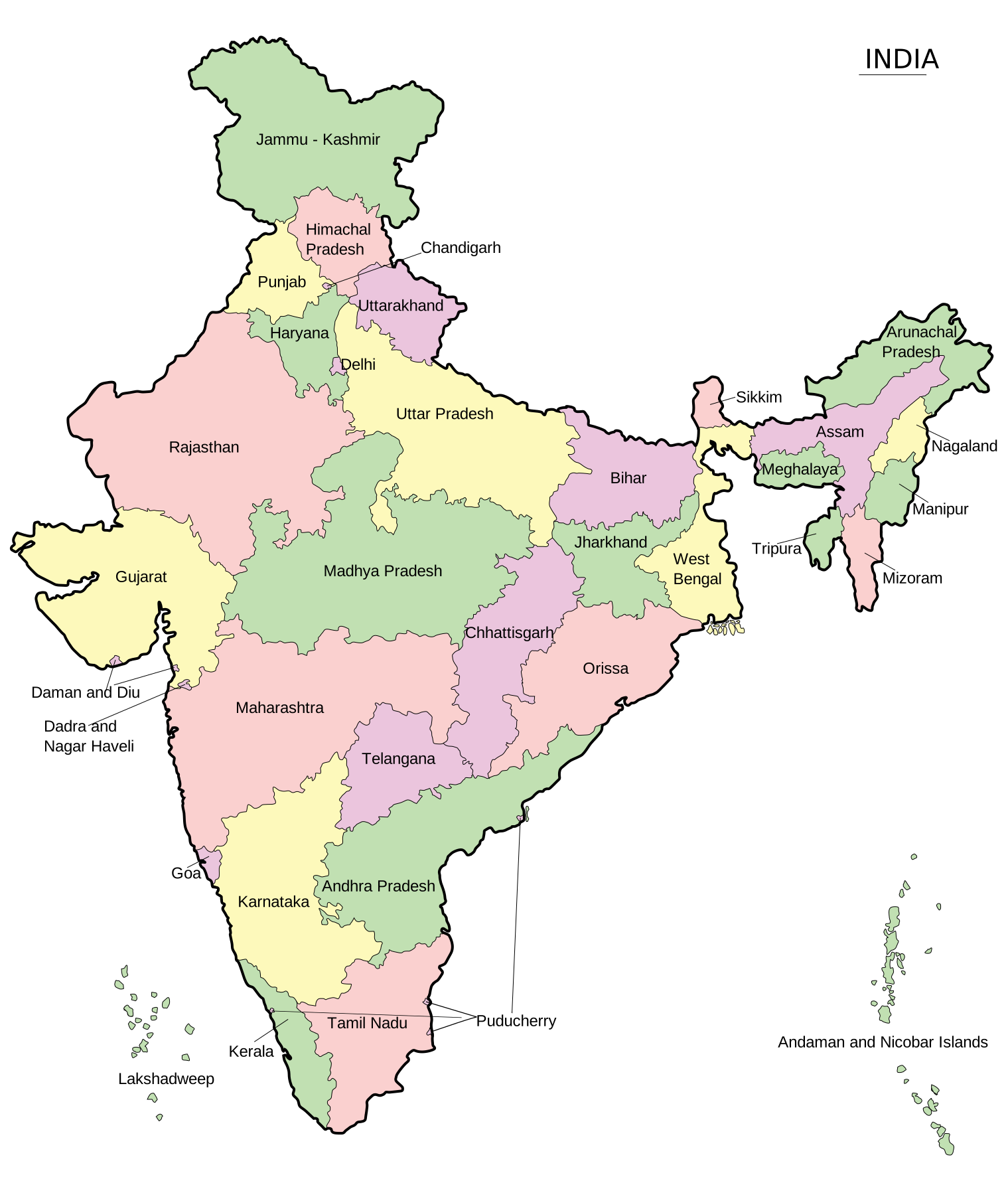
Identification of 14 Priority Landscapes: Delineates 14 critical conservation landscapes across the Northeast (Assam, Arunachal Pradesh, Meghalaya, Nagaland, Mizoram, Manipur, Tripura) and northern fringes of West Bengal and Bihar.
Standardized Scientific Monitoring: Mandates non-invasive technology—including environmental DNA (eDNA), camera traps, genetic sampling, and occupancy surveys—to establish India’s first reliable population baseline.
Habitat & Corridor Connectivity: Focuses on restoring degraded forest corridors outside conventional National Parks and Sanctuaries to reconnect isolated breeding populations.
Community-Centric Conservation: Involves local indigenous communities in anti-poaching monitoring while delivering sustainable livelihood alternatives to reduce forest dependence.
Context: On International Clouded Leopard Day, India’s Ministry of Environment, Forest and Climate Change launched the Clouded Leopard Conservation Action Plan (CAP).
Habitat Preferences: Prefers lowland dense tropical rainforests, but adapts to dry woodlands, mangrove swamps (in Borneo), and foothill forests of the Himalayas up to elevations of 2,743 meters (9,000 feet).
Wildlife Protection Act (WPA), 1972 (India): Listed under Schedule I.
About The Clouded Leopard Conservation Action Plan (CAP):
Distinguish the immediate development from the permanent mandate or structure of the institution concerned.
Revise exact names, dates, locations and legal or institutional terms from the source points; do not infer facts not stated there.
Examine the significance of “The Clouded Leopard”. Discuss its key implications and the way forward.
Begin with the immediate development and identify the central institution or policy issue.
End with a balanced, institutionally feasible way forward without making claims beyond the available evidence.